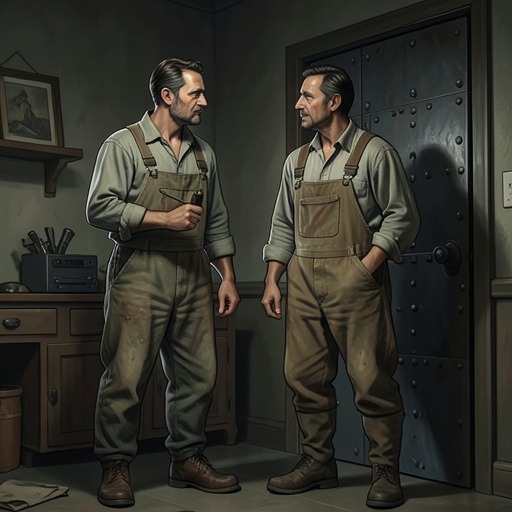
Cane Alexander—Max
The ExceptionCane Alexander and Max Quinn’s friendship is a working alliance as well as a source of emotional support. Max can check Cane’s temper without ceremony, share responsibility for their projects, and help respond when Simon Powers threatens the people and property around Cane. Their bond becomes clearest in crisis: Cane identifies Max as the person he can rely on, while Max’s concern extends beyond Jada Stanley’s safety to Cane’s own survival.
Foundation and Everyday Trust
The evidence presents Max as Cane’s best friend and a dependable presence in his professional life. Their closeness appears not through an account of how they first met, but through the ease with which they handle immediate problems together. At Alexander Industries, while a private investigator sits across from Cane, Max gives him a look that signals he should keep his temper in check. Cane follows the cue, maintaining a composed front despite his anger. The gesture suggests a familiarity that allows Max to intervene quietly and Cane to understand what is being asked of him without a prolonged exchange.
Their practical connection is visible in the work they share. Cane and Max must coordinate project responsibilities, including a delivery scheduled for the following morning. Cane notes that Max has arranged for Howard to coordinate subcontractors until further notice, but one of them still needs to sign the delivery ticket. This is not an abstract promise of support: Max is already handling an operational detail while Cane is occupied by a personal and security crisis. Their friendship therefore functions through delegated responsibility and sustained cooperation, not only through private declarations.
Coordination Under Pressure
The threat posed by Simon Powers tests the friendship across both business and personal concerns. When copper has been stolen, Cane reports that a police report has been filed and that local pawn shops will be alerted, though he doubts the property will be recovered. Max asks whether Cane has contacted Nick Parker, drawing attention to an established investigative channel rather than treating the loss as an isolated inconvenience. Cane confirms that he has. In the exchange, Max does not claim to control the investigation; he checks that a necessary step has been taken and remains ready to help further.
That readiness becomes more consequential as Simon’s threat grows. After consulting Nick Parker, Cane hears that police are monitoring Simon amid concerns about a large drug shipment moving through the Valley. Nick suggests that Jada and Cane may need protection and advises that Jada leave town temporarily. The advice makes distance part of the immediate safety plan, but Cane’s decision to send Jada away places him under emotional strain. Max is the person with whom he discusses that choice. Cane says he would rather have Jada in Chicago and alive than beside him in danger, and admits that he loves her. Max responds as someone who has already recognized the depth of Cane’s feelings, rather than treating the confession as news.
Emotional Reliance and Mutual Care
Cane’s trust in Max becomes explicit when he thanks him for his help and says, “You’re the only person in this world I can count on.” The statement gives their practical cooperation its emotional meaning. Max is not simply the colleague who can coordinate a delivery or the friend who can intervene when Cane is losing his composure; he is the one person Cane names as reliably present in a world shaped by betrayal and danger.
Max answers that dependence with care that runs in both directions. He has Jada taken care of, but urges Cane to take care of himself as well. He reminds Cane that people would miss him if anything happened, then brings the conversation back to their unfinished projects with a joke about not wanting to complete them alone. The shift from danger to work does not diminish the concern. It gives Max a familiar way to tell Cane that his life matters, while preserving the teasing, matter-of-fact tone of their friendship.
Crisis Partnership and Significance
The partnership’s practical dimension reaches its most urgent form when Cane is unable to speak safely and uses his phone to message Max. He tells Max to call the police and send them to his house, adding that he cannot answer questions and that Max must act immediately. The message relies on Max to understand the urgency and initiate outside help. It also marks a consequential choice: at the point when Cane needs intervention, he turns to his friend to bring the police into the situation rather than leaving the response solely to private action.
Across these episodes, their closeness is defined by complementary strengths. Cane bears responsibility for the business and makes the difficult decision to put Jada’s safety ahead of having her nearby; Max steadies him, manages tasks, checks that investigative steps are being taken, and watches over both Jada and Cane. The novel’s most direct statement of their bond is therefore matched by repeated conduct. Max’s loyalty is concrete, and Cane’s reliance on him is not merely spoken: when pressure leaves little room for explanation, Cane trusts Max to understand what must be done.